







Europe's Double Squeeze on Africa's Forests: What Ghana and Cameroon Reveal
Marta Abba
As Brussels tightens deforestation rules and dangles a new global forest fund, smallholder farmers in West and Central Africa are absorbing the real costs of an environmental transition designed far from their fields.
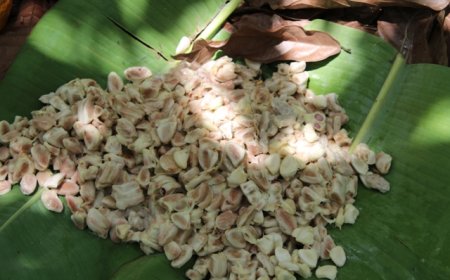
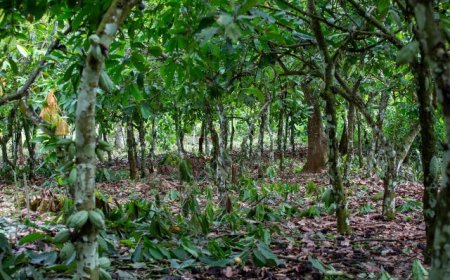
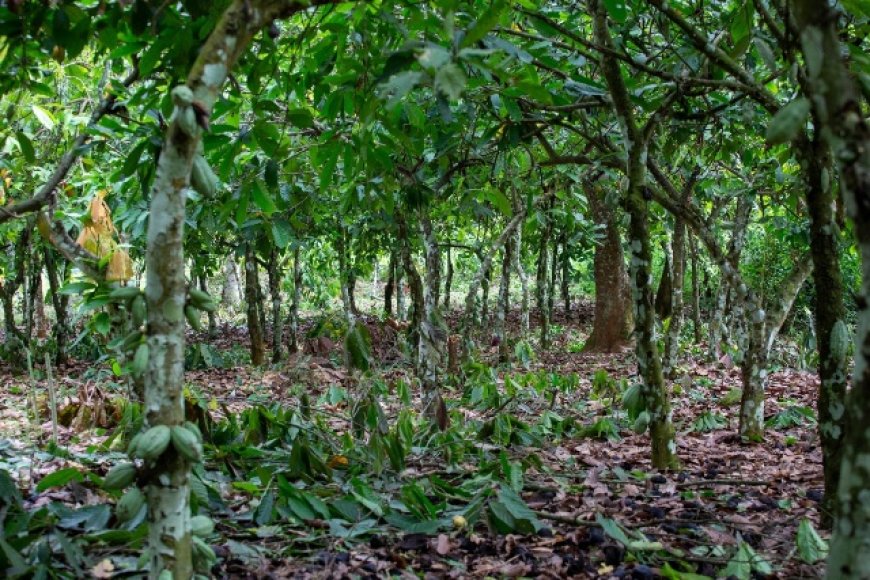
One detail recurs, almost word for word, in testimonies gathered in Ghana and Cameroon: labour costs are doubling. This is not a rhetorical flourish. It is how Obed Owusu-Addai, co-founder of EcoCare Ghana and coordinator of a cocoa farmers' cooperative, describes what it actually means for a smallholder to become "EUDR compliant." Clearing and maintaining a plot used to take two days. Now, to keep traceable cocoa segregated from conventional stock under the new European standards, it takes three. Labour costs rise accordingly — yet, as Owusu-Addai puts it, "we don't see the financial benefits reaching the cocoa pit," the farm gate where the crop is actually grown.
That is the blunt question underlying this investigation: what do I, the person who lives off this land, actually gain? It is the question that frames the tension between two instruments Brussels, Brasília and Northern policy circles present as complementary — the European Union Deforestation Regulation (EUDR) and the Tropical Forest Forever Facility (TFFF), launched at COP30 in Belém.
A Stick and a Carrot, Seen From a Distance
On paper, the logic is straightforward. The EUDR is a stick applied along the supply chain: unless a company can prove that a product — cocoa, coffee, timber, rubber — did not come from land deforested after December 2020, it cannot enter the EU market. The TFFF, by contrast, is designed as a carrot aimed at governments: it rewards countries that keep national deforestation rates low with annual payments, drawn from a fund targeting $125 billion raised through blended finance mechanisms.
Gideon Agyapong, a Ghanaian youth climate negotiator who followed the TFFF's launch in Belém, frames it as mutually reinforcing: the EUDR, he says, pushes supply-chain actors away from deforestation-linked activity, while the TFFF supplies the financial and operational means to sustain forest management. It is an optimistic reading, shared by those who helped build one of the continent's most advanced cocoa-traceability systems — Ghana's Cocoa Traceability System, which has now mapped more than 1.2 million farms across 1.38 million hectares.
But the further one moves from the policy chambers and closer to the ground, the more that complementarity dissolves into friction.
"This Law Isn't for Us. It's for Europe."
Owusu-Addai does not mince words. Comparing the EUDR to the earlier FLEGT-VPA timber agreement, he identifies a critical difference in process: under FLEGT, producing countries helped design the system alongside the EU; under the EUDR, "the EU decided to define its own technologies and, in a sense, imposed them on producer countries." He recalls a specific episode: roughly seventeen producing nations signed a joint letter to Brussels protesting inadequate consultation.
The result, on the ground, is a regulation farmers experience as an externally imposed cost rather than a shared opportunity — compounded by a second, more insidious problem: market access. If a Ghanaian farmer cannot certify his cocoa as deforestation-free, what happens to it? The answer he gets from local buyers, according to Owusu-Addai, is telling: it gets sold anyway, compliant or not, because "there are other markets everywhere." If access to Europe does not, in practice, hinge on an individual farmer's compliance — but is instead absorbed by the trading system as a whole — the incentive to invest time and money in traceability weakens almost to the point of vanishing.
Cameroon: Two Ministries, and a Dialogue That Isn't Happening
Where Ghana's institutional groundwork — GCTS, forest maps, a deforestation-risk model developed with the European Forest Institute — is relatively advanced, Cameroon's framework is more fragmented. Harrison Ajebe, who works with communities in the country's littoral and south-east regions on agroecology outreach, describes a government that signed the agreements with the EU but is struggling to translate them into operational capacity: "readiness is still questionable. The government has the goodwill, but how prepared are we — farmers especially? How prepared are we in terms of resources?"
An EU official based in Yaoundé, who has closely followed the cocoa and timber files, adds a detail that helps explain why dialogue remains so difficult: in Cameroon, forestry and environmental competencies are split between two ministries — MINEPDED for climate and biodiversity, MINFOF for forest resource management — "and that's typical of governance in Cameroon; every mandate ends up split in two, so it's very complicated." On the TFFF, she admits, the EU as an institution has done little to promote dialogue, "partly because the EU itself doesn't contribute financially" to the fund — it is individual member states, such as Germany and Norway, that do.
There is also a risk few discuss openly: that the focus on cocoa leaves another deforestation frontier unguarded — mining. The same official recalls, from a research project conducted with a Ghanaian colleague, concern about a shift toward gold mining — a sector the EUDR does not regulate — precisely in the areas where cocoa supply chains are under the most pressure. In Cameroon the phenomenon remains less visible than in Ghana for now, but, she concedes, "it needs to be studied, because honestly, we're not watching it closely enough."
The Fund That Isn't There Yet
On the TFFF, the gap between announcement and financial reality may be the most delicate point of all. Max Alexander Matthey, who tracks the fund's development closely, offers a sober technical assessment: as of mid-2026, sponsor commitments stand at roughly $6.8 billion, against an initial target of $25 billion. Norway, the largest contributor, has made its support conditional on capital thresholds that have not yet been met, pushing a final decision to its December budget.
The fund's financial mechanism, he explains, rests on a simple but risky premise: borrow capital cheaply, invest it in emerging-market bonds, and use the yield spread to pay countries that protect their forests. But that spread is not free money — it reflects real default risk. In a worst-case scenario, he warns, losses would be absorbed by donor countries' public capital while private investors remain shielded: "billions from public development-aid budgets would end up guaranteeing private investors."
Giacomo Cozzolino, who studies climate-finance dynamics, points to another underreported factor: competition between financing instruments. Nearly every dollar a donor country channels into the TFFF is a dollar diverted from another mechanism, not new money conjured from nothing. At a moment marked by broad cuts to international cooperation — the closure of USAID, reduced funding for the Green Climate Fund — the arrival of a fund as large as the TFFF, he argues, "adds uncertainty rather than certainty."
Who Pays the Penalty, Who Collects the Reward
One of the most concrete points Matthey raises echoes exactly what Owusu-Addai describes from Ghana: who actually receives the incentive. The TFFF imposes a penalty of roughly $400 per hectare deforested, deducted from a country's national transfer. That is a cost to the state's budget, not to the farmer who physically clears the trees. Whether that incentive ever reaches the farm level depends entirely on each government's redistribution policy — a step that, as the testimonies from Accra and Yaoundé suggest, is far from guaranteed.
The EUDR works differently, and more directly: loss of access to the European market hits producers immediately. But for that very reason, Matthey argues, the more concrete risk is not a budgetary conflict but a political one: a government can use the TFFF announcement as symbolic proof of environmental commitment while deferring harder reforms — even as EUDR compliance costs remain certain, immediate, and concentrated on those least able to absorb them.
A Question Sent From Far Away, Still Waiting for an Answer
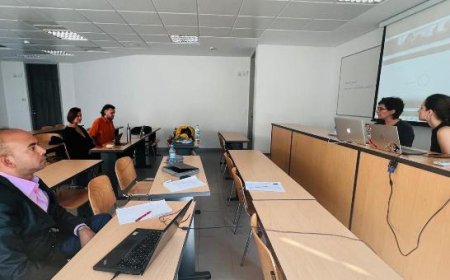
A single thread runs through all these accounts, even when they arrive in different languages — some interviews for this piece shifted between Spanish, French and improvised Italian, evidence of hurried conversations conducted by phone across time zones and unstable connections. The thread is this: two instruments designed to protect the same forests arrive, in the daily lives of the people who inhabit them, as two overlapping pressures rather than one coordinated system of support. On one side, the certainty of a cost — traceability, geolocation, doubled labour in the fields. On the other, the uncertain promise of a benefit that depends on capital not yet raised, governments not yet reformed, and a distribution of resources that, as Agyapong puts it, must "ensure the benefits reach those who serve as the daily custodians of the forest."
It is not a rhetorical question. It is the question a cocoa farmer in south-west Ghana or Cameroon keeps putting to a rulebook written elsewhere: if my land is worth more standing than cleared, who guarantees that — and when?
This investigation was produced with the support of Internews’ Earth Journalism Network in collaboration with Francis Tim Mbom
What's Your Reaction?