




























Pay Scale Paradox: Higher Salary, Lower Living Standard

Prof. Dr. Khan Md. Shaiful Islam

A pay scale is generally introduced to protect the purchasing power, dignity and living standard of public employees. When a government revises the pay scale after considering inflation, the intention is to restore the purchasing power employees have lost over the preceding years. However, when the newly adjusted pay scale remains unchanged for several years, the same problem of declining purchasing power begins again immediately after implementation.
The attached analysis demonstrates this hidden erosion of salary by taking 100 units of salary in 2015 as the baseline. If an employee continues to receive a basic salary of 100 units without adjustment, its real purchasing capacity declines every year as prices increase. The analysis shows that the salary required maintaining the purchasing power of 100 units in 2015 increased to approximately 179 units by 2025. In other words, an employee would need about Tk 179 in 2025 to purchase what Tk 100 could purchase in 2015.
The erosion becomes even more evident when purchasing capacity is considered. A fixed salary of 100 units retained only 50.72 units of its 2015 purchasing capacity in 2025. Thus, Tk 100 in 2015 had approximately the same purchasing power as only Tk 50.72 in 2025. The analysis also indicates that approximately Tk 197.15 in 2025 would have been required to maintain the purchasing power of Tk 100 in 2015.
The Bangladesh inflation data from 2015 to 2025 illustrate how this erosion occurs. Annual inflation was 6.19% in 2015, 5.51% in 2016, 5.70% in 2017, 5.54% in 2018, 5.59% in 2019, 5.69% in 2020 and 5.55% in 2021. Inflation subsequently increased to 7.70% in 2022, 9.88% in 2023, 10.47% in 2024 and 8.77% in 2025.
Consequently, the required salary index increased steadily:
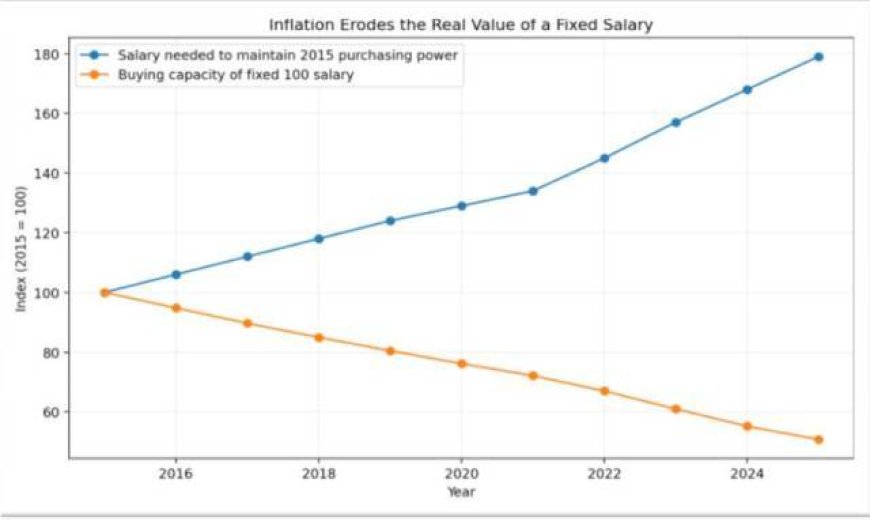
Table. Shows how public employee deprived by inflation corrected pay scale declared after certain duration
|
Year |
Inflation (%) |
Salary needed to maintain 2015 purchasing power |
Buying capacity of fixed 100 |
|
2015 |
6.19 |
100 |
100.00 |
|
2016 |
5.51 |
106 |
94.78 |
|
2017 |
5.70 |
112 |
89.66 |
|
2018 |
5.54 |
118 |
84.96 |
|
2019 |
5.59 |
124 |
80.46 |
|
2020 |
5.69 |
129 |
76.13 |
|
2021 |
5.55 |
134 |
72.12 |
|
2022 |
7.70 |
145 |
66.97 |
|
2023 |
9.88 |
157 |
60.95 |
|
2024 |
10.47 |
168 |
55.17 |
|
2025 |
8.77 |
179 |
50.72 |
Figure 1: How the salary required to increase to maintain purchasing power, but unfortunately reducing buying capacity due to gap between two pay scale commission?
The trend is clear: the cost of maintaining the same standard of living rises while the purchasing power of an unchanged salary falls.
This creates a fundamental weakness in a pay-scale system based on long intervals between revisions. Inflation is a continuous process, whereas a pay scale may be revised only periodically. Public employees do not wait several years before facing increases in food prices, house rent, transportation costs, education expenses, healthcare costs and other household expenditures. These costs rise year after year. Therefore, a pay scale that compensates for past inflation but ignores inflation occurring after its implementation is inevitably exposed to further erosion.
The effect can be particularly serious for lower- and middle-income public employees because they have less disposable income with which to absorb rising costs. As real income declines, employees may have to reduce consumption, savings, education expenditure, healthcare expenditure or other essential spending. Consequently, a nominal salary increase does not necessarily mean an improvement in living standards. What matters is the real purchasing power of the salary.
The problem can be illustrated by considering a new pay scale introduced after several years of accumulated inflation. Suppose an employee's salary is increased from 100 to 180 units in 2026 after accumulated inflation has been considered. At the time of implementation, this may restore much of the employee's lost purchasing power. However, inflation does not stop when the new pay scale begins. If prices subsequently rise by another 5-10% annually, the purchasing power of the 180-unit salary will again decline. After several years, the apparently generous new salary may no longer provide the living standard it was intended to provide.
Thus, employees repeatedly experience a cycle of old salary → inflation → loss of purchasing power → new pay scale → temporary recovery → renewed inflation → renewed loss of purchasing power → next pay scale. The benefit of a new pay scale is therefore strongest immediately after implementation and progressively weakens thereafter.
A more sustainable approach would be to introduce an annual inflation-adjustment mechanism into the public pay system. Instead of waiting for another major pay scale, salaries could be adjusted every year according to the average inflation rate of the preceding year or an officially determined inflation index. For example, if average annual inflation is 7%, the basic salary could be adjusted by approximately 7%; if inflation is 5%, the adjustment could be approximately 5%. This would not require a completely new pay scale every year. Rather, it would provide routine annual inflation compensation within the existing pay structure.
A possible policy formula is:
Adjusted basic salary = Previous year's basic salary × (1 + annual average inflation rate)
For example, if an employee's basic salary is Tk 50,000 and the officially determined average inflation rate is 6%, the inflation-adjusted salary in the following year would be approximately Tk 53,000. Such an adjustment could be applied automatically, subject to government policy concerning rounding, minimum adjustments and the treatment of different allowances.
Annual adjustment would primarily protect real wages, make pay policy more predictable, reduce the shock associated with large periodic pay-scale revisions and improve fairness. Instead of allowing purchasing power to deteriorate for many years and then attempting to correct the accumulated loss through a large salary increase, smaller annual adjustments could distribute the adjustment over time.
The data from 2015-2025 provide a simple demonstration. During this period, the purchasing capacity of a fixed 100-unit salary declined to approximately 50.72 units, while approximately 179 units were required to maintain the same purchasing power. Therefore, a pay scale that is adjusted for accumulated inflation only once and then remains fixed for many years cannot permanently protect employees from inflation.
The central policy question is therefore not simply how much the government increases salaries when a new pay scale is announced. The more important question is whether the salary system can continuously preserve the purchasing power of public employees. An annual inflation-based adjustment could provide a practical mechanism for achieving that objective while allowing periodic pay commissions to address broader structural issues.
Unfortunately, even an inflation-adjusted pay scale can disadvantage public employees in a developing economy. While inflation erodes purchasing power, the wider economy and private-sector incomes may grow faster. Thus if salaries are revised only periodically, public employees may suffer a double disadvantage—losing purchasing power to inflation while falling behind the rising living standards of others.
What's Your Reaction?