













"In the name of security, they are breaching our security" - Sharif Jamil
Marta Abba
At COP31, Bangladesh's best-known riverkeeper explains how the scramble for imported gas threatens the Sundarbans, the country's salt fields and a delta already running out of fresh water.
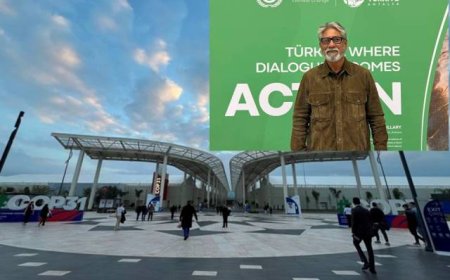
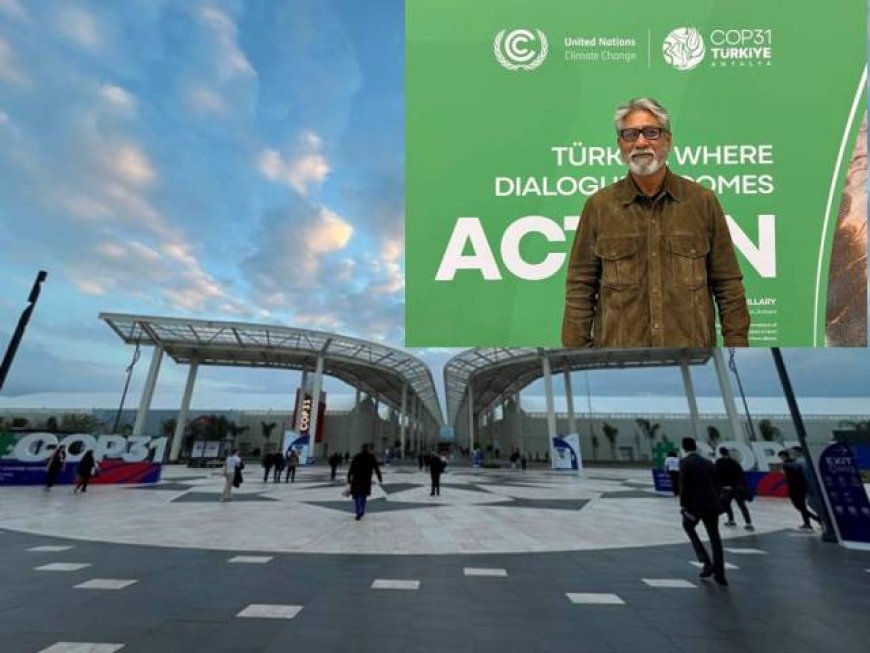
Antalya - COP31 will go down as the biggest climate summit ever held. With 92,934 participants registered, COP31 is provisionally the largest COP in history. Sharif Jamil, who has spent more than 25 years defending Bangladesh's rivers, thinks it will also be remembered as one of the emptiest. "In terms of participation, this is the biggest COP," he says. "In terms of results, it is the smallest."
He had come to Antalya expecting what everyone called an implementation COP, one that would finally set out institutions, timelines and money. Instead, he says, the talks "kept sidestepping all of that". Rich countries blurred the line between providing climate finance and merely "mobilising" it, even though "historically, they are the ones who emitted." The just transition mechanism agreed in Belém, which was supposed to become a working institution here, was left out. So were fossil fuels. The first draft of the cover decision still called for faster action on oil, coal and gas. The revised draft removes explicit references to phasing out fossil fuels while elevating carbon capture, utilization, and storage (CCUS) as a central mitigation pillar. "Technologies that are still unproven," Jamil says. "And the 1.5°C threshold is already upon us."
But the summit is not what he wants to talk about. Between two side events, his phone ringing constantly, the Buriganga Riverkeeper and coordinator of Waterkeepers Bangladesh turns to what is happening at home. At one point someone is waiting for him at the wrong entrance to his next event. "I'm giving a long interview," he tells them, and carries on.
"They keep going"
His most urgent worry is a new wave of floating LNG terminals. After the war with Iran choked supplies through the Strait of Hormuz, and a fire knocked out one of the country's two floating terminals, the government announced plans for three more: at Payra, Mongla and Hiron Point. Hiron Point lies inside the Sundarbans World Heritage Site, the world's largest mangrove forest.
"One of them is going to a place where it will destroy the Sundarbans," Jamil says. "The other two will take the crisis to two more places, and they will make communities that are already migrating even more vulnerable. Our coast is already living through a climate catastrophe, and they keep going."
The terminals are being sold as energy security, and international lenders have bought the argument. In May the World Bank approved another $350 million to help Bangladesh finance LNG imports. Jamil has raised it with the Bank directly. "In the name of security, they are breaching our security," he says. "They call it strengthening the energy sector, but the money goes to buying LNG from abroad."
His objection works on two levels. "Imported energy can't give you security. It makes you dependent." And the infrastructure lands on the most fragile part of the country. "Our whole coastline is protected by mangroves, and these projects are clearing them. An LNG plant never comes alone. It brings infrastructure and industrialisation, and the farmland disappears."
The Japan problem
Much of the planning behind Bangladesh's fossil build-out has Japanese fingerprints, and Jamil does not hide his disappointment. "Japan is our biggest development partner. It has been a tested friend," he says. "But if you invest in our power sector, you can't also shape our energy policy. That is a conflict of interest."
The story starts with the 2010 Power System Master Plan, prepared for the government with the help of Japan's aid agency JICA and the Tokyo Electric Power Company. According to Jamil, it projected "a fictitious level of demand" and recommended a wave of coal plants running on imported coal, each sited on a river estuary next to an ecological treasure. Rampal sits beside the Sundarbans. Payra, in Patuakhali, sits on the main migration route of the hilsa, the national fish. UNESCO sent two monitoring missions and asked for a strategic environmental assessment. "It wasn't done properly," he says. "There was no scientific integrity." In 2021 the plan was rewritten as the Integrated Energy and Power Master Plan, which shifted the focus from coal to LNG. His organisation is about to publish an updated report on it.
The flagship is Matarbari, on the coast of Cox's Bazar, the heart of the Moheshkhali-Matarbari Integrated Infrastructure Development Initiative. A coal plant, a deep-sea port and proposed LNG terminals are going up in the district that produces 95 per cent of the country's salt. "For Bangladesh, salt is a strategic product," Jamil says. "We are a nation of fish and curry. There is no household without salt."
He says the assessments were inadequate: no modelling of mercury, and SOx and NOx but not PM2.5. Five or six thousand salt farmers protested because nobody had consulted them. After public meetings in Japan, he says, a promise was made to hear them. "More than two years have passed, and they still haven't met them."
Then there is the Kohelia, a tidal river that JICA's own environmental assessment shows was lined with a 7.35-kilometre embankment and road for the coal plant. Locals depended on the river for salt, transport and fishing, and much of it was filled in. "At first they said it was the government's responsibility, not theirs. But it's their financing, for their coal plant," Jamil says. A promise to dredge it was never kept. "In Bangladesh, a river is a living entity."
The fishers were the first to feel it. "We started studying these communities before they were living this crisis. Now they are living it," he says. "They aren't finding fish, and they know the pollution comes from the plants." Thousands have protested.
Salt in the rivers
For all the talk of disasters, Jamil insists the real crisis in Bangladesh is the slow one. "People know us for our floods. But the climate crisis isn't a special event for us. It's every day."
Salt water is creeping inland, driven both by the rising sea and by shrinking flows from upstream. "In the dry season there isn't enough fresh water to hold the salinity back," he says. "More than 18 districts are in a water crisis." He has seen it in Gopalganj, not far from Dhaka, and estimates the intrusion now reaches about 100 kilometres inland. "The salt doesn't only come in from the sea. It comes in through the rivers."
People are moving as a result. The Internal Displacement Monitoring Centre counts more than 21 million disaster displacements in Bangladesh since 2008. Jamil cites older figures that he has spent years asking the authorities to update: more than a million people a year losing their homes, about 40 per cent of them ending up in already overstretched cities. "The country is barely above sea level," he says. "In effect, it is all coast."
The new government has made solar equipment duty-free and set a goal of 20 per cent renewable electricity by 2030. Jamil welcomes it, but only up to a point. "It's good, but it isn't enough to stop the LNG expansion," he says. "You can't change an energy architecture in a day."
That is why he keeps coming back to the COPs, however little they deliver. His hope for Antalya is modest: enough progress "so that when the world meets in Ethiopia next year, it can achieve something."
Then his phone rings again, and he is off to find his next audience, still waiting at the wrong door.
(Marta Abba is an Italian investigative journalist and contributor to Our Voice Online)
What's Your Reaction?