










The EUDR's Blind Spot in Ghana: Brussels Polices Cocoa, Overlooks Gold
Marta Abba
The EU's deforestation regulation is tightening its grip on Ghanaian cocoa. Gold mining, which drives at least as much forest loss, remains almost entirely outside its scope.
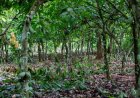
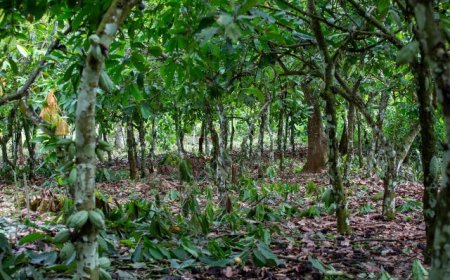
At dawn in Begoro, in Ghana's Eastern Region, Sammy Takyi walks slowly between rows of young cocoa trees. The soil is still cool. Broad plantain leaves, planted deliberately alongside the seedlings, filter the early light and shield them from the heat to come.
His five-acre farm has tested his patience for five years now: cocoa yields nothing quickly — it takes four to five years before the first real harvest. "You don't just plant and wait," he says. "The plantain feeds and protects the seedlings. That's how you survive before the harvest comes."
Two years ago, on this same land, Sammy considered clearing it all. "I was tired," he admits. "The situation for farmers is discouraging. There are no real incentives. You wait for years, and when the harvest comes, the money doesn't reflect the effort."
He is not alone in that calculation. Across Ghana's cocoa belt, many farmers are weighing the same choice, as illegal gold miners — the phenomenon known locally as *galamsey* — encroach further onto their land, offering cash upfront. Since 2021, galamsey has destroyed nearly 9,000 hectares of officially protected forest reserves — roughly the area of 13,400 football pitches.
In Prestea Huni-Valley, in the Western Region, municipal chief farmer Nana Boakye puts it in terms of prices: a sack that once sold for 3,625 cedis now fetches 2,587. "They say the world price has fallen. But things haven't gotten easier here." He has watched families sell everything and end up with nothing, and others who, by cooperating with illegal miners, keep extracting income from their land regardless. "Many of the laws governing cocoa haven't changed in years. Enforcement is weak. Farmers feel abandoned."
Onto this already strained landscape, a European rule has now arrived with the opposite aim: stopping deforestation.
Two Commodities, Two Different Standards
In 2023, the European Union adopted the EUDR, its deforestation regulation, requiring companies that import cocoa, coffee, palm oil, soy, cattle, rubber and timber to prove their products are not linked to forest destruction. Large companies must comply from 30 December 2026, smaller ones from 30 June 2027 — after two delays — but the sector is already reorganising. COCOBOD, the state cocoa board, is building a digital traceability system that geolocates individual farms, while the Forestry Commission prepares reference maps of deforestation.
There is, however, a glaring gap in the text: gold is not covered. "Cocoa is monitored for deforestation risk. Gold, which contributes enormously to that same deforestation, is not subject to the same controls," notes agri-food expert Kojo Ahiakpa. Gold has already overtaken cocoa as Ghana's top export earner — and just as the European regulation tightens its hold on one commodity, it leaves the other untouched.
For Christoph Wiedmer, who has studied global gold supply chains for over a decade, the imbalance is structural: "These regulations often cover timber, soy, cocoa. But not minerals. It's important to include them, especially given the use of mercury, as in the Amazon region — it's extremely polluting and harmful to people." The problem, he adds, is also cultural: gold "is treated as an investment, even though most of it ends up in the jewellery sector" — and, unlike a chocolate bar, it draws far less scrutiny from European consumers.
In practice, this two-speed approach carries a concrete cost. "For a farmer in a remote area, with limited access to the internet or technology, the geolocation the EUDR requires adds another layer of cost and stress," says Ahiakpa — while anyone who abandons cocoa for galamsey answers to no one.
Who Bears the Heavier Burden
Martha Opoku Mensah, who works in cocoa sector development, points out that the burden falls unevenly among farmers. "Everyone will struggle with the EUDR, but women face greater barriers. Many farm alongside their husbands, but the land is registered in his name — without land ownership, they lack the collateral to access credit." And because they often cannot clear the more demanding plots on their own, they must pay for labour that men, in many cases, avoid.
Not everyone is convinced the new traceability system will hold up under pressure, either. Carla D. Martin, who chairs the board of Harvard's Institute for Cacao and Chocolate Research, acknowledges the EUDR has opened a conversation about deforestation that was previously taboo, but warns: "I'm already hearing there are ways to get around the system. Fake geolocation points can be sold." John Newell, founder of the UK-based Tree2Bar, spells out the commercial risk: if significant volumes of Ghanaian cocoa become unsellable in the EU, "chocolate makers will turn to other countries, like Ecuador" — with effects that could, over time, damage Ghana's reputation, already tested, Ahiakpa notes, by wariness from markets such as Japan and the UK over mining-related contamination.
The Gold No One Fully Traces
While cocoa's traceability path is, on paper, becoming ever tighter, Ghanaian gold follows a different route — often through Dubai, ending up at Swiss refineries, which alone handle a vast share of the global market. For Hannah Mowat, of the NGO FERN, the weakness is not so much the law itself as the absence of a system to enforce it: "If we introduce a regulation without a traceability system, the regulation is completely useless because we don't know how to apply it. Switzerland and the UK should also be helping these countries build such systems" — much as is now being attempted, with difficulty, for cocoa.
Sammy Takyi is not talking about European regulations as he walks among his plantain trees in Begoro. He is talking about a harvest that is still years away, a price that keeps falling, neighbours who have already handed their land to miners. But it is in that gap — between one commodity under increasingly close watch and another left almost untouched, grown on the very same soil — that the answer will be decided: whether he, and others who keep planting cocoa instead of digging, will still have a reason to stay.
This investigation was produced with the support of Internews’ Earth Journalism Network in collaboration with Afia Agyapomaa.
What's Your Reaction?