









Where the Fire Was
Marta Abba, Viktoriia Hubareva and Elisabetta Zavoli
Charcoal leaves scars that can last for centuries. Europe's appetite for cheap barbecue fuel is now cutting new ones in Ukraine, South America and Africa, on land, on lungs and on the people who make it.
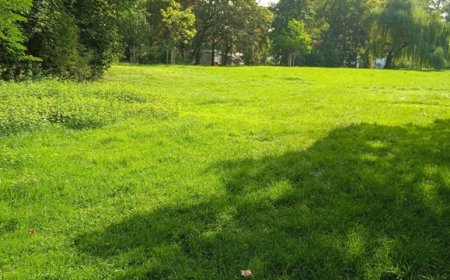
On the mountain paths of Lessinia, north of Verona, you sometimes step into a clearing that seems to have been drawn with a compass. It is round, a few metres across, flattened into the slope like a terrace. The beech wood closes in around it. Very little grows inside.
These circles are the floors of old charcoal kilns. Some were productive from the thirteenth century until the middle of the nineteenth, when the last charcoal burners left. More than 150 years later the ground has been yet healed. "The soil is rich in carbon, but it becomes heavy and asphyxiated, and plants can't grow on it," said Alessio Mencarelli, a researcher in the Department of Land, Environment, Agriculture and Forestry at the University of Padua, who studies charcoal and its emissions. The trees around the clearing close their canopy over it, light stops reaching the ground, and the circle stays empty. You find the same marks all along the Apennines, he said.
Nobody has measured how long the same damage lasts when charcoal is made today, in steel barrels on open fields. "There are no studies," Mencarelli said. "But if it is done on the same plot for years in a row, plants will struggle to come back, because the physical and above all the chemical properties of the soil change."
New circles
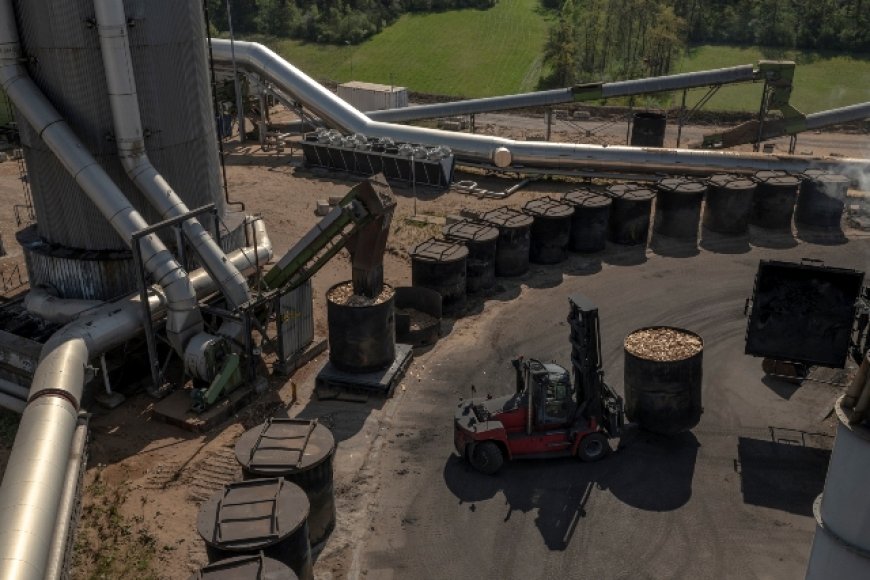
Some of those plots are in northern Ukraine. Outside the village of Shybene, in the Kyiv region, a court ruled in 2025 that a charcoal operation had left arsenic, manganese and boron in the soil above legal limits. Arsenic levels were a quarter higher than the maximum allowed. The man in charge accepted a plea deal and paid a fine of 30,600 hryvnia, about 600 euros. When our team went back after the ruling, one barrel was lit and a worker was feeding it wood.
In Vyhiv, in the Zhytomyr region, the barrels belong to a company called Carbon Pro and stand on land that, according to a court, is meant for farming. We stood at the fence. Inside, a guard dog, a working kiln, and a man filling bags with charcoal using his bare hands, without a mask or eye protection.
In the autumn of 2025, investigators searched the site in a case of illegal logging, abuse of office and money laundering, and took soil samples and residue from the barrels. They also seized bags already printed for the French market. Shipping records show that Carbon Pro sends its charcoal mainly to Romania, France and Poland, and in smaller amounts to Belgium and the Netherlands.
A legal Ukrainian producer, who agreed to talk on condition that we did not publish his name, described the land that feeds these barrels: strips of woodland between fields, communal forests, scrub and small plantations that nobody fully registers. Without records, nobody checks what is cut and nobody replants. The wood, he said, can then be dissolved into a certified supply chain by declaring a false conversion rate between wood and charcoal, or by buying paperwork for logs that were never used. "On paper everything is legal. The real wood comes from somewhere else."
By his count, of the roughly 10,000 tonnes of Ukrainian charcoal sold in Europe in the first eight months of 2025, between 1,500 and 3,000 came from legal production. His own plant has stopped working.
The forests further away
Ukraine is the closest source. Most of Europe's charcoal comes from much further. The continent burns about a million tonnes a year and imports around 750,000 of them from outside the EU, from countries including Nigeria, Cuba, Paraguay, Namibia and Argentina, according to research by WWF Germany and the Thünen Institute in Hamburg.
When the institute's wood anatomists examined charcoal bought in Italian shops, they found tropical or subtropical wood in more than 65 percent of the bags. Some of it came from the Gran Chaco, the dry forest shared by Paraguay, Argentina and Bolivia, including species protected under CITES, the convention on trade in endangered species. "If that wood ends up on a barbecue in Italy, I would call it an unacceptable waste," said Volker Haag, a wood scientist at the Thünen Institute of Wood Research, whose team identifies the species inside charcoal under the microscope.
Italian shoppers had no way to know. Only one bag in four said what wood it contained or where it came from, and more than half of those statements were false. Haag described labels reading "made in Croatia" on charcoal whose wood came from somewhere else entirely. In Germany, Austria and Switzerland his team found mostly certified products and few labelling problems. In Italy, he said, they found the opposite.
The people at the start of these chains rarely appear in any data. Anne-Mette Lekdorf Soler-My, marketing and communication director of the French producer Groupe Soler, recalled a documentary that followed an FSC auditor into a charcoal camp in Namibia. The workers slept four to a bungalow, on the floor. The cost of their protective clothing came out of their pay.
Haag believes voluntary labels cannot carry this weight. He wants binding social standards written into European law, together with rules against deforestation "whether it is illegal or legal", because private actors, in his view, are either unable or unwilling to enforce them. The EU Deforestation Regulation was meant to bring charcoal under traceability rules for the first time, but its start date keeps moving. "For now the EUDR is just theory," Haag said.
Lukas Feiler, who works on charcoal supply chains at the Earthworm Foundation, a non-profit based in Switzerland, has watched buyers lose interest. "Ten years ago there was a wave of awareness against illegal imports, but it only reached the sellers," he said. "Now we have no regulation, no public opinion, no awareness."
The last person in the chain
At the end of every supply chain there is someone standing over a grill. Research by the University of Padua, cited by the Italian charcoal brand C95, found that this person is the first one at risk, breathing the gases that rise from the coals. Mencarelli thinks the risk is underestimated because charcoal feels natural. "There is this popular belief that the oldest fuel in the world can't hurt you," he said. "Unfortunately, it can."
Nobody tracks the fruit-tree wood that some brands add for flavour, either, or the pesticides it may have absorbed. "Nobody asks for that information," Mencarelli said, "so producers don't go looking for a problem."
Italy burns about 65,000 tonnes of charcoal a year, and more than seven bags in ten come from outside Europe. Inside the country, making charcoal survives as a family craft in Calabria, where a few households around Serra San Bruno still build earth-covered mounds and watch them for weeks, and as a series of experiments. A prototype kiln on Monte Amiata, in Tuscany, worked in trials and stopped there. In Lessinia, where the old circles are, a first modern plant was abandoned because it used too much energy, and a second, the Carega project, is still on the drawing board. C95 sells pyrolytic charcoal made in Portugal from park-maintenance wood, at 37 euros a bag, in about thirty specialist shops.
Smoke that becomes light
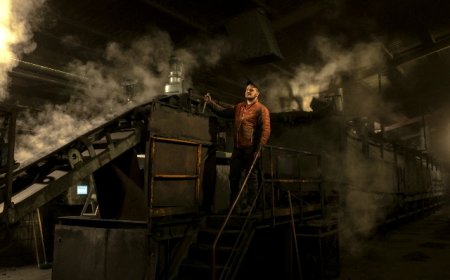
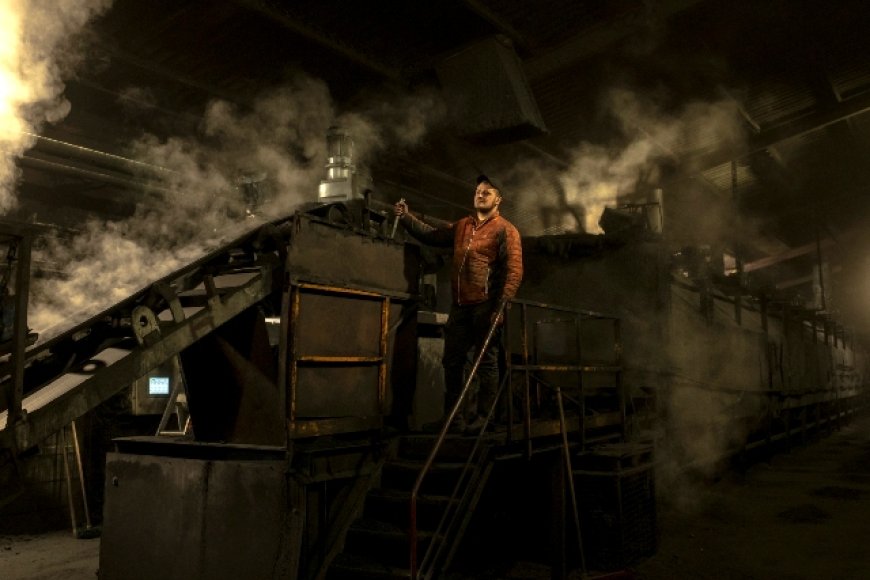
The clearest answer to the question of whether charcoal can be made without leaving a scar is in Gyé-sur-Seine, a village in the Aube, in north-eastern France. Our team visited the Soler plant there. The kilns are closed steel retorts, ten tonnes of wood each, fed with residues from French forests. A supervisor stays in the control room around the clock, following temperatures that reach a thousand degrees and infrared cameras that spot any hot point before it becomes a fire.
The gases that in Zhytomyr drift across the field are piped away, cooled with water and burned to make electricity, enough for about 15,000 homes. The heavy metals that trees absorb from soil and air are captured in the process instead of falling back onto the land. Because no wood is burned to keep the fire going, the plant uses 4.7 kilograms of wood for each kilogram of charcoal; traditional kilns need about 11. The finest fraction becomes biochar, which local farmers spread on their fields and a cement company uses in place of a fifth of its fossil fuel.
Building it took the Soler-My family more than ten years and 25 million euros for the first plant alone, raised privately once the French state agreed to buy its electricity for twenty years. Before that, Lekdorf Soler-My said, the family imported charcoal "like everyone else" to stay afloat. Today the group runs three plants, employs around 200 people and can produce about 50,000 tonnes a year. Its prices are under constant pressure from imported bags in French garden centres, including Grill O'Bois, a brand whose importer appears in Carbon Pro's shipping records.
Lekdorf Soler-My does not think the war in Ukraine explains much. "Before the war it was exactly the same," she said. "The war is an excuse."
In Gyé, the smoke ends up in the national grid. In Vyhiv, it settles on a field and on the bare hands of the man who bags the charcoal. Mencarelli cannot say how long that field will need to recover once the barrels are gone. In Lessinia, more than a century and a half has not been enough.
(This article was produced in collaboration of three journalists and with support from Journalismfund Europe.)
What's Your Reaction?