









The Weight of the Backpack: When GPS Becomes a Tool to Expose Poaching
- Marta Abba
I walk through the meadows of Friuli Venezia Giulia, a region in northeastern Italy, not far from Osoppo and Gemona, where 19 years ago a devastating earthquake claimed nearly 1,000 lives and left over 3,000 injured. Today it appears as a land reborn, dotted with small villages at risk of abandonment, but those who remain stay attached to traditions as well, hunting included. Legal and otherwise.
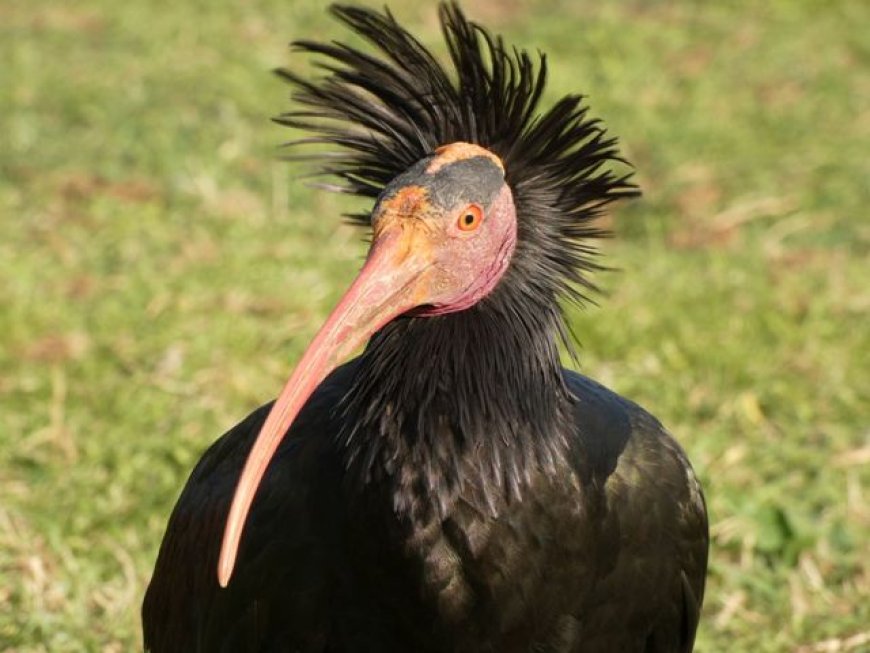
Beside me are volunteers and operators from the LIFE project, a European conservation programme dedicated to the Northern Bald Ibis, a species of migratory bird that disappeared from Europe in the 17th century and is now the subject of an ambitious reintroduction programme. It was launched in 2014 and renewed in 2022; every day the Waldrapp team manages its various activities. I am with its Italian representatives, with the head of the anti-poaching campaign, and I am visiting the crime scenes. The crimes. The places where poachers have killed these protected birds.
Veterinarian Stefano Pesaro from the University of Udine knows these meadows well and knows well the work that awaits him each time an injured or shot Northern Bald Ibis arrives. For over 15 years he has received their bodies, recovered by operators or volunteers, at the clinic of the Research and Coordination Centre for Wildlife Recovery in Pagnacco. If they are still alive he tries to save them; otherwise he focuses on searching for lead pellets hidden in the tissues, to provide as many elements as possible to reconstruct the crime scene. Through X-rays, Pesaro can determine both their size and type, both pieces of information extremely useful for the law enforcement agencies tasked with combating illegal hunting in the area. Friuli Venezia Giulia is an Autonomous Region; there is a Regional Forestry Corps.
Coordinating this specialised structure, Claudio Tomasi knows well that in poaching investigations the speed and thoroughness with which the first intervention is carried out are fundamental. Tomasi explains that Italian hunting legislation is extremely complex and hunters, when accused of violating laws, appeal at every judicial level rather than lose their hunting licence. Regarding cases of poaching with Northern Bald Ibis victims, Tomasi defines them as “inexplicable”. “The only interest could be represented by the value of the stuffed specimen for a collector,” he explains, “but almost always the killed specimens have not been recovered by the poacher. Hunting is an atavistic passion, not rationally comprehensible.” But traceable, at least in the case of ibises.
My wandering through the crime scenes and, even more importantly, the rapid and precise intervention by law enforcement and the Waldrapp team, are both unique and rare opportunities when it comes to illegal hunting. They exist for the Northern Bald Ibis because there is a LIFE project for their conservation that equips them with GPS, making them always precisely locatable and recording every anomaly in their movement. For this reason, if hit by a projectile, as soon as they stop flying as they have learned to do, the alert is immediately triggered to search for them. One hopes to find them alive; if they are already dead, everything possible is done to find whoever is responsible. To do everything possible, the Waldrapp team together with the Udine Prosecutor’s Office is working on a collaboration protocol that also involves veterinarians and the Regional Forestry Corps. The idea is to define “best practices” in the early phases of intervention in order to correctly collect elements useful for investigations. It would be an important pilot project, to be replicated in other areas and to serve as a deterrent for those who practise poaching.
With their GPS devices on their backs, the Northern Bald Ibises are changing the game. They highlight a problem that affects many other species not so well tracked. At the same time they call on Italy to unite forces against poaching. At least that part of Italy that truly wants to combat it, because “the political will to do so doesn’t really seem to be there and the overall picture remains murky” according to Rosario Fico, head of the National Reference Centre for Veterinary Forensic Medicine at the Experimental Zooprophylactic Institute of Lazio and Tuscany.
Fico has worked for years on cases of killed Northern Bald Ibises, analysing GPS data together with autopsy results to reconstruct the angle of shots, the shooting distance, even the poacher’s position relative to the animal. In his experience, “despite the very many reports filed, the cases that actually go to trial and result in convictions are truly negligible,” he states. “This is because poaching is never considered as a social phenomenon, yet it is. Those who practise it have family members, usually the father, grandfather or another male relative to whom authority is recognised. They are local people who know the territory perfectly, who have lived there for generations.” Poaching, Fico explains, is an aspect of social deviance. “Fundamentally these individuals do not respect nature protection laws because they consider them, in their conception, oppressive and unjustified. It is inherent in the cultural DNA of some Italian local populations who over the centuries have developed managerial autonomy independent of any central authority.”
All of this emerges clearly, case by case, place by place, only thanks to the Northern Bald Ibises and the GPS devices they wear. They weigh 25 grams but have 99 high-sensitivity channels, three accelerometers that detect the bird’s body movements and position on three axes, an altimeter, temperature sensors and battery charge status sensors, and a satellite geolocator that detects position with a maximum inaccuracy of a few metres. All this is powered by a small solar panel that recharges an internal lithium polymer battery. A small miracle of engineering that reveals the dimensions of poaching in Italy, a phenomenon that kills over a third of the hundred or so ibises that disappear from the radar each year. To make it increasingly effective, the Austrian Waldrappteam is continuing to develop the technology to find the right balance between GPS utility and animal welfare. This mission is shared with Austrian engineer Herwig Grogger, a lecturer at Graz University of Applied Sciences, who has collaborated with the Waldrappteam since 2015. He has even built a wind tunnel—a passage where one can study how birds fly and how GPS devices affect the aerodynamics of their flight.
The tunnel was created in 2017 inside a former stable in the Austrian countryside a few kilometres from Salzburg. It is a modest infrastructure, built in wood due to limited budget, watched over by an elderly pig that still lives in the stable and frequented by young Austrian engineering students who have made the wind tunnel their thesis project. “In 2015-2016 we started doing the calculations: how big are the birds, how big must the wind tunnel be, what velocity must be produced for the birds to fly in a stationary position,” Herwig recalls. The problem was serious: the first GPS trackers, when fixed too high on the birds’ backs, caused ocular opacity, compromising the animals’ sight. “It was very stressful for the birds to be in the wind tunnel: the loud noise, flying in a confined space with a wall above their heads instead of open sky. The birds didn’t want to do it, they wanted to fly in the company of their fellows, not alone in a closed room,” Herwig explains. But the breakthrough came thanks to the work of two students who, for their thesis project, created a three-dimensional digital copy of the Northern Bald Ibis through detailed scans and then printed a physical 3D lookalike. This model is now used to create fluid simulations of wind and aerodynamic pressure distribution.
“It’s a big step forward. We have all the data that would be impossible to measure on a live bird. We no longer need experiments with live animals because now we have a scanned bird in a totally digitalised environment. We can work with this digital bird without needing other animals for experiments.” Herwig is fully aware of the ethical dilemma that runs through the entire project: “Yes, we need technologies to save these birds from extinction, but we cannot say that this technology has no impact on their natural life. It’s a difficult dilemma to resolve. Technology is necessary to save the birds, but technology is also a burden, a weight that the birds must carry and that changes their natural behaviour. For this reason we must continue to minimise the impact of technology, make the devices ever smaller and lighter.”
Corinna Esterer observes the progress of her team colleagues and sees the effect each time she fits a young Northern Bald Ibis with its GPS backpack. She does this at the German breeding colony on Lake Constance where she has worked for years. Before, she was the mother of the ibises, teaching them to fly for many years. Now she cares for them daily: monitoring the breeding colonies, observing who pairs with whom, how many chicks are born, how many manage to take flight. “You have to be dedicated to do this work, you have to have empathy,” she confesses, “but no particular skills are needed. Yes, the little backpack can bother them, but it protects them during the long journey that awaits them: almost 800 kilometres across the Alps, from Germany and Austria to Italy.” The weight of the backpack is also the weight of responsibility: being witnesses, being living proof, being the voice of those who have none.
Article produced in collaboration with Brigitte Wenger, with the support of Journalismfund Europe. (www.journalismfund.eu)
What's Your Reaction?