




Preparing for Uncertainty: A Suspended Mission
- Marta Abbà
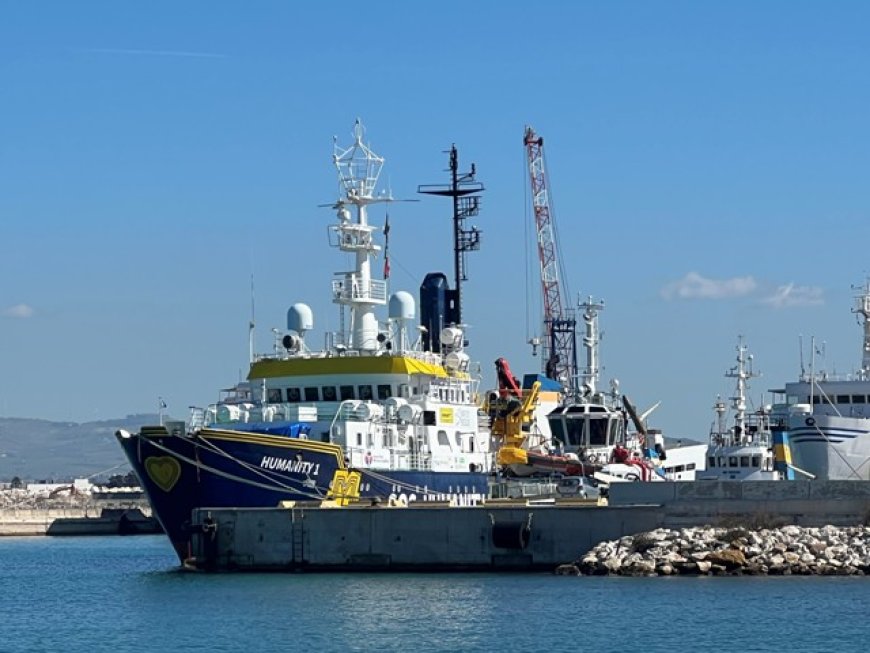
The central Mediterranean is often calm, but beneath that surface, the sea tells stories of escape, fear, and survival. The Humanity 1, a ship operated by the German NGO SOS Humanity, is designed to respond to these emergencies.
With checked engines, lifeboats ready, and supplies of food and fuel sufficient for weeks, the ship and its crew are trained to help people in distress.
Onboard, every role is precise and essential. Stefania, is the Protection Representative: she registers survivors, identifies vulnerabilities, and coordinates information to facilitate their access to services on land. Frances is the coordinator of survivor well-being, responsible for ensuring that the care team – composed of doctors, paramedics, midwives, psychologists, and cultural mediators – operates in an integrated way to provide holistic support, guidance, and practical tools for dealing with the uncertainty ahead.
Under normal circumstances, Stefania and Frances begin their work immediately after a rescue: recording data, reconstructing family units, identifying unaccompanied minors, assessing vulnerabilities, and conducting basic legal information sessions. The team provides psychological support, medical first-aid, information about rights, guidance on accessing health and legal services on land, and practical tools to reduce uncertainty for survivors. Every activity aims to prepare people to face a future that is inevitably uncertain. Work on Board: Preparing for Uncertainty
Stefania describes her role as follows: “When survivors come on board, the first step is to register them. We collect information about people's age, country and origin, which are then transferred to the bridge and subsequently to the competent authorities to request a safe port in Italy. Immediately after, we reconstruct family units and identify unaccompanied minors, always with the help of cultural mediators.”
Frances adds: “My job is to coordinate the well-being of survivors. We have to ensure that every member of the care team operates in an integrated manner, providing medical, psychological, and practical support. Every gesture serves to reduce uncertainty and help people orient themselves before disembarking.”
Working with women is particularly delicate. Some travel alone, others with children or during pregnancy, and many have experienced violence or abuse. “We cannot resolve all trauma, but we can provide concrete tools: information, useful contacts, psychological and medical support. This allows them to face the future with greater confidence,” Stefania explains.
Unaccompanied minors and women represent the most vulnerable groups on board. Constant observation, listening, and dialogue with cultural mediators and psychologists allow the team to detect signs of vulnerability and plan specialized support on land. Frances ensures that the care team works in a coordinated and coherent manner, balancing immediate needs with preparation for the future. Every day on board combines practical activities and moments of listening, procedural simulations, informative sessions, and individual consultations. The goal is clear: to provide concrete tools, reduce uncertainty, and prepare survivors to manage the complexity of life once disembarked.
However, during rotation 25, none of this work could take place.
Forced Immobility: The Detention of the Humanity 1
On February 13, 2026, the Humanity 1 was stopped in Trapani by Italian authorities with a sixty-day administrative order and a fine of ten thousand Euros. The accusation: failing to communicate with the Libyan Rescue Coordination Centre during a rescue operation.
The ship, although ready and fully equipped, remained moored between Trapani and Syracuse. The planned crew rotation was officially canceled on March 18. The Humanity 1 could move only between ports, with engines ready and trained personnel on board, but without any possibility of intervening to save lives or accommodate survivors.
Lukas, SOS Humanity’s Communications Manager, recounts the practical and organizational consequences of the detention: “Three weeks of waiting consume physical and mental energy. The ship is ready, the crew is trained, but we cannot act. Every day of immobility is a delay for people at sea who need help.”
The Humanity 1 is not an isolated case. It is part of the civil fleet, an alliance of NGOs operating in the central Mediterranean, which over the years has seen other ships blocked in port: the Sea-Eye 4, the Ocean Viking, and the Iuventa have faced similar detentions, some lasting weeks, others months. These blockages demonstrate how administrative measures can slow rescue operations and put lives at risk.
Political and Legal Context
The detention of the Humanity 1 occurs within a broader legislative context. The Italian government, led by Giorgia Meloni, discussed a law allowing naval blockades of up to six months for reasons of “security,” a broad definition that also includes migratory pressure. At the European level, the Migration and Asylum Pact, in force since June 2026, introduces mechanisms for outsourcing asylum procedures and agreements to divert migrants outside EU borders. NGOs like SOS Humanity thus become the last visible obstacle to increasingly restrictive control of the Mediterranean. The Humanity 1, blocked for weeks, embodies the conflict between international law, national regulations, the requirement of coastal states to ensure effective search-and rescue operations for people in distress.
A Suspended Mission
Despite their preparation for the current mission, the work of Stefania and Frances with survivors could not take place. The ship was ready, the care team on board, but people at sea could not receive support or be brought aboard. Every day of waiting in port served as a reminder of the fragility of the system: even those with the technical capacity and experience to save lives can be prevented from doing their work by administrative orders.
The story of the Humanity 1 illustrates how fragile the balance is between sea rescue, international law, and national regulations. The ship remains ready, the volunteers are motivated, but forced immobility prevents them from carrying out what normally defines the core of their work: rescuing people from distress at sea, providing emergency medical support, food etc., preparing survivors for uncertainty and providing concrete tools to face the future.
What's Your Reaction?